


Most outbound programs do not fail because the emails are bad. They fail because the list is wrong. When a rep works a hundred accounts that were never a fit, the reply rate drops and the whole channel looks broken even when the execution was fine.
The numbers behind that problem are easy to underestimate. Gartner estimates that poor data quality costs organizations an average of $12.9 million per year, and research from MIT Sloan Management Review puts the revenue lost to bad data as high as 15 to 25%.
Time is the other cost. According to Salesforce’s State of Sales report, the average seller now spends only about 40% of the workweek actually selling, with much of the rest going to research and admin. Every hour spent chasing an account that will never close is an hour taken from one that might.
An ideal customer profile fixes the input side of that equation. It tells you which companies deserve your outreach before a single email goes out. This guide covers how to define an ICP, how to size the market it describes using TAM, SAM, and SOM, and how to turn all of it into a prospect list your team can actually work.
What is an ideal customer profile (ICP)?
An ideal customer profile is an account-level description of the company that gets the most value from your product and returns the most value to your business. It operates at the level of the organization, which is why it answers the question of which companies to sell to rather than which individuals. Firmographics like industry, company size, and revenue sit at the center of it, along with signals about how a company operates and what it already uses.
An ICP works as a filter. Its job is to concentrate limited outreach on the accounts most likely to buy and stay, and that focus is where its effect on pipeline quality comes from.
ICP vs. buyer persona vs. target market
These three terms get used interchangeably, and that confusion is expensive because each one does a different job.
Your target market is the widest layer. It is every company that could plausibly use a product like yours, before any qualification is applied.
Your ICP narrows that market to the companies that fit best, defined by concrete attributes rather than a general category.
A buyer persona then goes one level deeper, inside the account, to the individual who evaluates and signs. If the ICP describes the company, what a buyer persona is describes the person you email inside it.
You need the account view and the person view working together. The ICP decides which doors to knock on, and the persona shapes what you say when someone answers. For a fuller breakdown of audience layers, see our guide to the types of target audience and how to reach each one.
The 5 building blocks of a B2B ICP
A workable ICP is built from a handful of attribute types. Use as many as your data supports.
- Firmographics. Industry, company size, headcount, revenue, and location. These are the coarse filters that remove most of the market quickly.
- Technographics. The tools and platforms a company already runs. A prospect on a CRM you integrate with is easier to win than one you have to rip and replace.
- Behavioral and trigger signals. Recent funding, hiring for specific roles, expansion into a new region, or a leadership change. These indicate that a company is in motion and more likely to buy now.
- Pain and use case. The specific problem your product removes. If a company does not have the pain, firmographic fit will not save the deal.
- Disqualifiers, or the negative ICP. The traits that make a company a bad fit no matter how good it looks on paper. Writing down who you will not pursue is as useful as writing down who you will.
How to define your ICP, step by step
Step 1: Mine your closed-won data
Start with the customers you already have, specifically the ones you closed and kept. Pull your last 50 to 100 closed-won accounts and look for the attributes that repeat. In most B2B datasets, a small set of traits shows up across the majority of your best accounts, and those repeating traits are the raw material for your profile. Gut feel is a weak substitute here, because the accounts that feel ideal are often the ones a rep remembers rather than the ones that actually paid and renewed.
Step 2: Interview customers and your sales team
Data tells you what fits. Conversations tell you why. Talk to 10 to 15 of your best customers about the problem that pushed them to buy and what nearly stopped them. Then talk to the reps who close and the customer success team that renews, since they see fit and friction that never make it into the CRM. This is also where you separate correlation from cause, so your profile reflects the reasons accounts succeed rather than surface coincidences.
Step 3: Find the shared traits and score them
Turn the patterns into criteria, then weigh them. Attributes do not carry the same predictive weight, so a simple scoring model works better than a flat checklist. Give more points to the traits most strongly tied to closed-won and retained revenue, and fewer to nice-to-haves. A 100-point rubric that lives in your CRM as scoring fields is more useful than a document nobody opens, because it lets you rank accounts automatically as they enter the pipeline.
Step 4: Write the one-page ICP (and the anti-ICP)
Your finished profile should fit on a single page. Anything longer stops getting used. State the firmographic range, the technographic and behavioral signals, the core pain, and the disqualifiers. The anti-ICP matters as much as the profile itself. When your team knows which accounts to skip, reps stop spending hours on companies that were never going to convert, which is exactly where the selling-time problem starts to reverse.
TAM, SAM, and SOM: sizing the market your ICP defines
Once you know who fits, the next question is how many of them exist and how much revenue they represent. That is what market sizing answers, and the standard framework for it is TAM, SAM, and SOM.
What TAM, SAM, and SOM actually mean
Each term is a smaller circle inside the last.
- TAM, total addressable market, is the total revenue available if every company that could buy your product did. It is the whole category.
- SAM, serviceable available market, is the slice of TAM you can actually serve given your product, pricing, geography, and business model.
- SOM, serviceable obtainable market, is the portion of SAM you can realistically win in the near term, given your sales capacity and the competition already in those accounts.
For a clean reference on the definitions and the math behind them, HubSpot maintains a detailed TAM, SAM, and SOM guide. The relationship is what matters: TAM contains SAM, and SAM contains SOM.
Top-down vs. bottom-up (and why bottom-up wins for outbound)
There are two ways to size a market. The top-down method starts with a large industry figure from an analyst report and applies a share assumption to it. It is fast, and it tends to overstate the opportunity because industry numbers include segments and geographies you will never sell to.
The bottom-up method goes the other direction. You count the actual companies that match your ICP and multiply by the revenue you would earn from each.
As HG Insights explains in its market sizing guide, bottom-up sizing produces a number you can defend because every input traces back to observable data.
For an outbound team, bottom-up is the practical choice. A top-down slide gives you a headline number for a board deck. A bottom-up model gives you a count of real accounts, which is the same thing as the top of your prospect list.
How to calculate each, with a worked B2B example
Here is a simplified bottom-up pass for a mid-market B2B SaaS company. The numbers are illustrative.
Start with TAM. Suppose 50,000 companies worldwide fall into your product category, and your average annual contract value is $18,000. That puts TAM at roughly $900 million.
Narrow to SAM. You sell in English-speaking markets, you serve companies between 200 and 2,000 employees, and you integrate with one specific CRM. Applying those filters leaves about 5,000 companies you can actually serve, or roughly $90 million in SAM.
Estimate SOM. Given your current sales capacity and the competitors already in those accounts, a realistic near-term capture might be around 6% of SAM. That is about 300 accounts and $5.4 million in year-one obtainable revenue.
Those proportions are typical. Practitioners often see SAM land somewhere between 1 and 10% of TAM, and near-term SOM between 5 and 15% of SAM. Use those ranges as a sanity check rather than a fixed rule, and always cross-check a bottom-up number against a top-down estimate to catch bad assumptions.
From ICP to a targeted prospect list
Market sizing is not an academic exercise for outbound. Your SAM is your prospect universe, and the work now is turning it into a list you can actually contact.
Turning ICP criteria into list filters
Every attribute in your ICP becomes a filter in a data tool or database. Industry and headcount ranges narrow the universe. Technographic and trigger signals then rank what is left, so accounts showing recent funding or relevant hiring rise to the top of the queue. The output is a segmented list where the highest-fit, highest-intent accounts get worked first.
Our guide to B2B prospecting methods covers the tactics for pulling and prioritizing those accounts, and our outbound prospecting strategy walkthrough shows how to sequence them once the list exists. If you are still deciding how to segment, the piece on finding your target audience with AI is a useful companion.
Keeping the data clean: decay, enrichment, verification
A list is only as good as the data under it, and that data goes stale fast. B2B contact data decays at roughly 30 percent per year as people change jobs and companies restructure.
A list built in January is measurably worse by summer if nothing maintains it. That is why enrichment and verification have to run continuously rather than as a one-time step, and why keeping your prospect data synced through your CRM integrations matters as much as the initial pull. Clean data protects the selling time you freed up by tightening the ICP in the first place.
How AnyBiz operationalizes your ICP
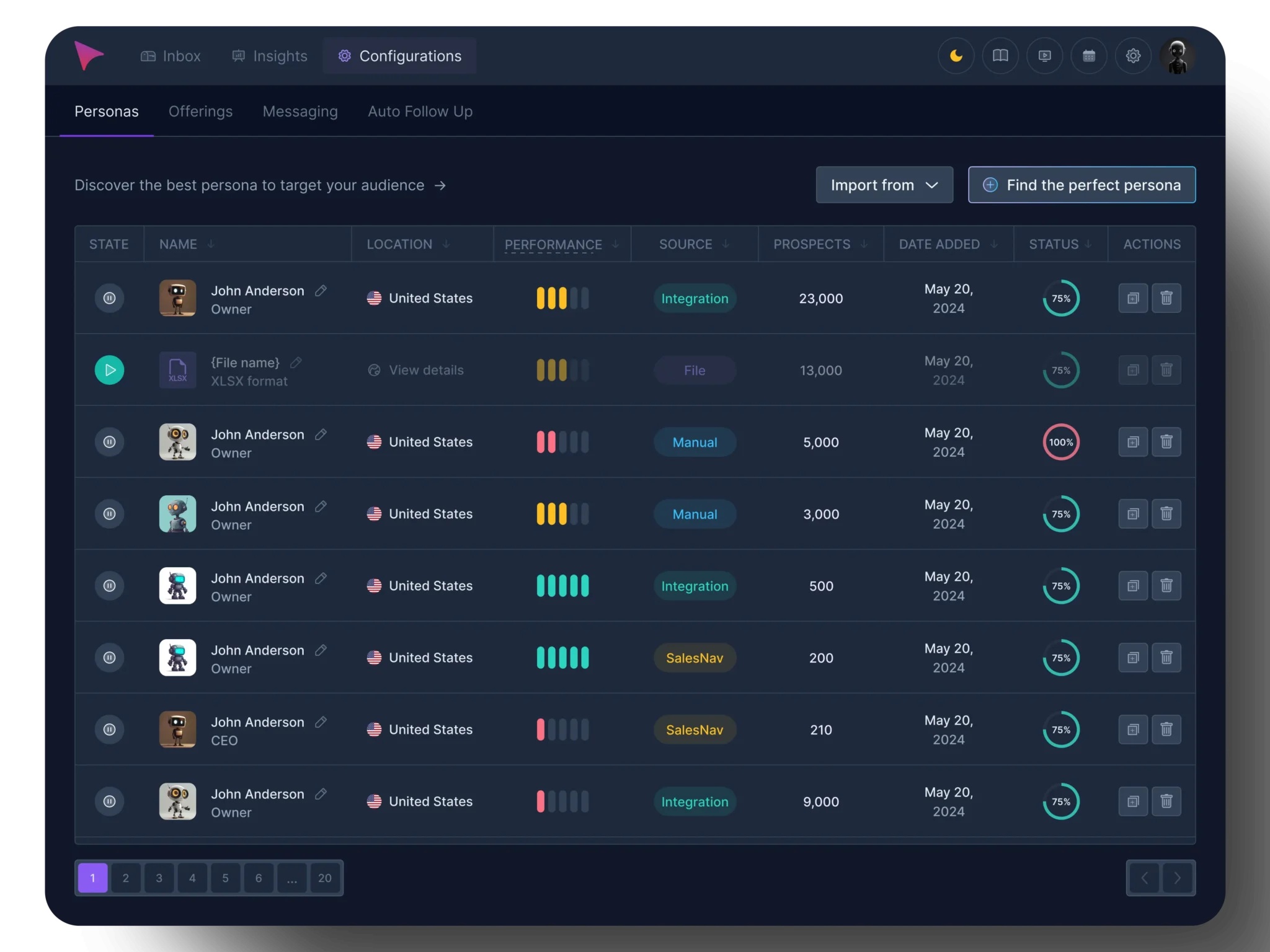
Defining an ICP and sizing a market is strategy. Running it is where most teams stall, because the execution takes copywriting, deliverability, and constant list maintenance at a volume that is hard to sustain by hand. That is the gap the AnyBiz AI SDR platform is built to close.
Defining your Offering and Persona
AnyBiz runs on the same inputs you just built. You define your Offering and your target Persona, and the platform’s AI agents translate that into prospecting and outreach across a database of hundreds of millions of contacts.
The ICP work in this guide is the setup that makes that targeting accurate, since the agents are only as good as the profile you give them.
Multichannel outreach across email, LinkedIn, and phone
A single channel rarely carries a cold account on its own. AnyBiz coordinates AI email outreach, an AI LinkedIn assistant, and AI phone calls from one place, so a prospect who ignores an email may still respond on another channel in the same week.
Because the agents run continuously, the highest-fit accounts from your SAM get consistent, personalized touches without adding headcount. The broader shift shows up in the data too.
Salesforce reports that 87% of sales organizations now use some form of AI, and that top-performing sellers are 1.7 times more likely than their peers to use prospecting AI agents for outreach.
Conclusion
An ideal customer profile is the most consequential document in an outbound program, because everything downstream inherits its accuracy. Get it right and both your list and your messaging point at the same set of winnable accounts.
Sizing that market with TAM, SAM, and SOM turns the profile into a real number, and a bottom-up SAM turns that number into the top of your prospect list. If you want to pressure-test the payback before you build, the AnyBiz ROI calculator models what a tighter, better-targeted outbound motion is worth.
Ready to put your ICP to work?
Want to see how AnyBiz turns your ICP into a live, multichannel outbound campaign? Book a Demo and walk through it with a specialist.
FAQ
What is the difference between an ICP and a buyer persona?
An ICP describes the company that fits your product best, using account-level attributes like industry, size, revenue, and tech stack. A buyer persona describes the individual inside that company who evaluates and approves the purchase. You use the ICP to choose which accounts to target and the persona to shape the message once you reach someone.
Is an ICP the same as your target market or TAM?
No. Your target market, and the TAM that measures it, is the entire universe of companies that could buy your product. Your ICP is a much narrower definition of the companies that fit best. The target market tells you how big the opportunity is, while the ICP tells you where to focus first.
How do you calculate TAM, SAM, and SOM?
The most defensible method is bottom-up. Count the companies that match your ICP and multiply by your average annual contract value to get TAM, apply practical filters like geography and product fit to reach SAM, then estimate a realistic near-term capture rate to get SOM. Cross-check the result against a top-down industry estimate to catch faulty assumptions.
How often should you update your ICP?
Review it at least once a year, and sooner if you see warning signs like rising churn in a segment or a falling win rate where you used to be strong. Because B2B data decays quickly, the account lists built from your ICP need refreshing far more often than the profile itself.
How many accounts should be in your ICP for outbound to work?
There is no universal number, but your serviceable available market should be large enough to sustain outreach without exhausting itself and small enough that every account is a genuine fit. If your SAM is only a few hundred accounts, outbound alone may not fill the pipeline. If it runs into the tens of thousands, tighten the profile so reps work the best-fit accounts first.