


Lead generation still decides which B2B SaaS companies grow and which ones stall, but the way the pipeline gets built changed quickly between 2024 and 2026.
Buyers now complete most of their research before they ever speak to a rep, and a growing share of that research no longer starts in a search box.
In its 2026 Answer Economy report, G2 found that 51% of B2B software buyers now begin vendor research inside an AI chatbot such as ChatGPT or Perplexity, up from 29% in April 2025.
At the same time, AI has moved from a talking point to standard sales infrastructure. Gartner found that sellers who effectively partner with AI tools are 3.7 times more likely to hit quota than those who do not.
Salesforce, in its seventh State of Sales report based on more than 4,000 sales professionals, found that 54% of reps have already used an AI sales agent and 87% of organizations use AI in some form for tasks like prospecting, forecasting, and drafting outreach.
Understanding B2B SaaS lead generation
B2B SaaS lead generation is the work of identifying the decision-makers who could buy a software product, then guiding them from first contact to a sales-ready conversation.
In practice, that means reaching people such as CFOs, IT directors, VPs of engineering, and RevOps leaders, understanding the problem they are trying to solve, and giving them enough relevant information to move forward.
The stakes are high in SaaS for a specific reason. Recurring revenue depends on a steady flow of qualified prospects, and a single closed deal can represent years of subscription value. A well-run lead engine does more than fill the top of the funnel.
It also builds market visibility and signals credibility to buyers who are comparing several vendors at once.
What has changed most is how teams measure success. High-performing organizations now judge lead generation on lead-to-opportunity conversion and cost per qualified lead rather than raw form fills, because volume alone tends to flood sales with contacts that never convert.
The challenges of B2B SaaS lead generation
Effective lead generation is difficult, and the reasons have shifted alongside buyer behavior.
- Reaching a precise audience. Needs, budgets, and buying processes vary widely by industry and company size, so broad outreach rarely produces qualified conversations.
- Self-educating buyers. Modern professionals research most of a purchase on their own and tend to filter out generic messaging. Outreach has to match the buyer’s current problem to earn a response.
- Crowded categories. Many SaaS niches are saturated, so a clear reason to choose you over a competitor matters as much as the product itself.
- Data decay. B2B contact data goes stale quickly as people change roles and companies, which quietly undermines targeting accuracy and the AI models built on top of it.
- A new confidence gap. As buyers lean on generative AI, they also weigh how reliable it is. Gartner research reported by Demand Gen Report found that 51% of buyers say they are more likely to encounter misleading information from generative AI, and 49% say the same about a sales rep, which keeps human validation important at key moments.
How AI is changing B2B SaaS lead generation
AI has reset the operating standard for lead generation, mostly by handling analysis and repetitive work at a scale people cannot match. Three shifts stand out.
- Predictive analysis. Models can process CRM records, website behavior, engagement history, and external signals to estimate which prospects are most likely to convert, then rank them so teams focus where the odds are best.
- Automation of research and drafting. Gartner found that AI now saves sellers an average of 4.8 hours per week by taking over account research, first-draft messaging, and follow-up scheduling. The firm also predicts that by 2027, 95% of sellers’ research workflows will begin with AI, up from less than 20% in 2024.
- Personalization at scale. AI makes it practical to tailor content and outreach to a prospect’s role, industry, and stage instead of sending everyone the same message.
The results are not automatic, though. The same Gartner research found a widening divide, with 25% of sales organizations reporting a return of 50% or more on their AI investment while 20% report a negative return of 50% or more.
The difference tends to come down to data quality and process design rather than the tools themselves. That context matters for every strategy below.
Top 10 AI-driven B2B SaaS lead generation strategies
1. Predictive lead scoring
Predictive lead scoring uses machine learning to rank prospects by their probability of converting. Instead of the handful of attributes a manual model tracks, modern systems weigh dozens of signals at once, from engagement patterns and firmographics to technographic data and buying signals, then update as new outcomes come in.
However, a scoring model trained on incomplete or outdated records will confidently rank the wrong leads, which is why clean CRM data is a prerequisite.
How to put it to work
- Connect your CRM, marketing automation, and product usage data into a single pipeline the model can learn from.
- Train the model on 12 to 18 months of closed-won and closed-lost outcomes so it learns what conversion actually looks like for your business.
- Set score thresholds that route high scorers to sales immediately and send mid-tier scores into nurture.
- Refresh scores on a regular cadence and align sales and marketing on a shared definition of a qualified lead.
2. Content personalization and recommendations
Content personalization tailors what a prospect sees, such as articles, case studies, and product recommendations, based on their behavior, role, and industry. AI analyzes past interactions to surface the piece most likely to move a specific visitor forward.
The revenue case is well documented. McKinsey research shows that personalization most often drives a 10% to 15% revenue lift, with company-specific results ranging from 5% to 25%, and improves marketing spend efficiency by 10% to 30%.
Faster-growing companies derive about 40% more of their revenue from personalization than their slower-growing peers.
Personalization has also become a baseline expectation rather than a differentiator. In its 2026 analysis of B2B growth, McKinsey found that more than 90% of organizations now personalize content across email, websites, and social channels, and that market leaders are four times more likely than laggards to deploy true one-to-one personalization, at 20% versus 5%.
How to put it to work
- Unify first-party data so the system can recognize a returning visitor and what they care about.
- Segment by role, industry, and buying stage, then map content to each segment.
- Use dynamic pages and recommendations that adapt in real time to behavior.
- Measure impact on conversion velocity and deal size, not on clicks alone.
3. Conversational AI and chatbots for engagement
AI chatbots greet visitors, answer questions, qualify interest, and book meetings around the clock. Advances in natural language processing mean today’s bots hold context-aware conversations rather than following rigid scripts, and adoption has become mainstream.
Grand View Research values the global chatbot market at 9.6 billion dollars in 2025, projected to reach 41.2 billion by 2033.
Speed is the mechanism that makes chatbots effective for lead generation. A prospect engaged the moment their interest peaks is far more likely to convert than one who waits hours for a reply, and a bot delivers that response instantly, at any hour.
The limits are worth respecting. Generative bots can produce inaccurate answers when they are not properly grounded, and complex or high-value conversations still perform better with a person, so a clean handoff to a human matters.
How to put it to work
- Give each bot one clear job, such as qualifying leads or booking demos, rather than asking it to do everything.
- Use proactive triggers based on time on page or exit intent instead of waiting for a click.
- Capture name and email within the first few steps so a lead is still recorded if the visitor leaves.
- Integrate with your CRM and build a fast escalation path to a human rep for qualified prospects.
4. Email marketing optimization and deliverability
Email remains the highest-return channel in B2B. Litmus places its ROI at roughly 36 dollars for every dollar spent, and found that brands that frequently use dynamic, personalized content report a higher return, around 44 dollars per dollar, than those that rarely do, at about 36.
The most important 2026 addition to this strategy is deliverability. Since Google and Yahoo began enforcing sender requirements in 2024, authenticated sending through SPF, DKIM, and DMARC is a condition for reaching the inbox at all, not an optional best practice.
Sender reputation and proper warm-up now sit upstream of every other email tactic, because even a perfectly personalized message earns nothing from the spam folder.
How to put it to work
- Authenticate your sending domain and monitor reputation before scaling volume.
- Warm up new sending infrastructure gradually to protect deliverability.
- Use AI for predictive segmentation, dynamic content, and send-time optimization.
- Track revenue per recipient and conversions rather than relying on open rates.
5. Social media insights and targeting
Social platforms, and LinkedIn in particular, are where B2B intent surfaces. LinkedIn is consistently reported as the leading source of B2B social media leads, and its native lead forms tend to convert well above standard landing-page benchmarks because they remove friction from the capture step.
AI adds value by listening at scale. Social analytics tools scan conversations, posts, and engagement to surface trends and intent signals, which lets teams build campaigns around the roles and problems most likely to respond.
The strongest results tend to come from coordinating channels rather than running them in isolation, since outreach that combines email, LinkedIn, and phone consistently earns more replies than email alone.
How to put it to work
- Build campaigns by buying role, since a CFO and a RevOps leader respond to different messages.
- Use AI social listening to identify accounts showing intent, then prioritize them.
- Coordinate LinkedIn with email and phone as one motion, and track engagement at the account level.
6. AI lead generation platforms and AI SDRs
This category matured the most between 2024 and 2026. What began as broad automation is now agentic AI, where autonomous AI sales development representatives research prospects, build lists, draft personalized outreach, and manage follow-up across channels with limited supervision.
The practical model that is winning keeps humans in the loop. AI SDRs take over the research, qualification, and first-draft layer that once filled an SDR’s morning, while reps keep control of the conversations that close deals.
That split protects two things at once, namely sender reputation and message authenticity, because buyers in 2026 can recognize generic automated outreach and filter it out.
Platforms in this space, including AnyBiz.io, connect to a company’s CRM, email, and LinkedIn to run multichannel outreach, then pass qualified prospects to human reps.
How to put it to work
- Choose a platform that integrates cleanly with your CRM, email, and LinkedIn stack.
- Keep a human review step before AI-drafted messages reach a prospect.
- Measure net-new pipeline sourced through the agent, not just activity volume.
7. AI search optimization: SEO plus GEO
Search optimization is where the biggest behavioral shift is playing out. Traditional SEO now shares the stage with generative engine optimization, sometimes called answer engine optimization, which is the practice of structuring content so AI systems cite and recommend your brand inside their answers.
The data explains the urgency. G2 found that 51% of B2B software buyers now begin vendor research in an AI chatbot. Similarweb reported that zero-click Google searches grew from 56% to 69% in the year after AI Overviews launched, meaning more queries end without a visit to any website.
The optimization playbook has adjusted in response. The foundational GEO study from Princeton, Georgia Tech, the Allen Institute for AI, and IIT Delhi, presented at ACM KDD 2024, found that targeted techniques such as adding statistics, citations, and quotations can lift a page’s visibility in AI answers by up to 40%. GEO also compounds with SEO rather than cannibalizing it: Similarweb’s answer engine optimization analysis, drawing on Seer Interactive data, found that pages cited in an AI Overview earn about 35% more organic clicks than non-cited competitors.
Traffic that does arrive from AI answers also tends to convert well, because the buyer has usually already done their research.
How to put it to work
- Add structured data and schema so AI systems can parse your content.
- Publish original data, statistics, and expert quotes, which get cited more often.
- Lean into comparison content, product pages, and case studies with real numbers, which are harder for AI to synthesize away.
- Distribute through earned media and third-party publications, since much of what AI cites comes from sources other than your own domain.
8. AI-driven sales intelligence
Sales intelligence pulls scattered signals, including social activity, web visits, and public data, into a detailed picture of a prospect and their likely needs.
AI then recommends the next best action, so reps engage with context instead of guesswork.
Gartner found that sales organizations that provide sellers with AI-enabled next best actions are 2.6 times more likely to achieve commercial growth, and that organizations prioritizing AI upskilling are 2.4 times more likely to achieve strong revenue growth.
The firm also expects 95% of seller research workflows to begin with AI by 2027.
The human layer still matters here. The same research shows that even as buyers use AI to research vendors, they turn to reps to validate AI-generated insights and build confidence at critical decision points, so intelligence works best when it augments a rep’s judgment rather than replacing it.
How to put it to work
- Connect the tool to your CRM and sales platforms so it can build complete prospect profiles.
- Surface intent signals and a recommended next step for each account.
- Keep reps in control of the strategy, using intelligence to sharpen their approach.
9. Voice and natural language interfaces
Voice search and natural language processing let prospects interact with a product and its support the way they speak, without navigating menus. AI phone systems, voice assistants, and multilingual interfaces make that engagement available around the clock.
Grand View Research values the global conversational AI market at 11.58 billion dollars in 2024, projected to reach 41.39 billion by 2030, with a compound annual growth rate of about 23.7%.
For lead generation, the value is lower friction and broader reach. A prospect can ask about features, pricing, or support in plain language and get a coherent answer immediately, and multilingual capability extends that experience to markets a smaller team could not otherwise serve.
How to put it to work
- Integrate voice and NLP into your product and support channels through a unified interface.
- Train the system on your industry’s terminology so it interprets queries accurately.
- Review the most common questions to inform product and content decisions.
10. Predictive analytics for market trends
Beyond scoring individual leads, predictive analytics can forecast where a market is heading by analyzing historical patterns alongside current signals.
That lets a SaaS company anticipate shifts in buyer preferences and industry demand, then position content and campaigns to meet that demand as it forms rather than after it peaks.
Demand forecasting and market modeling are among the AI use cases McKinsey identifies as engines of B2B growth, alongside personalization and scaled AI in commercial workflows. The practical benefit is timing, since a campaign aligned with an emerging need reaches buyers earlier and wastes less effort on demand that has already been captured.
As with scoring, output depends on input. Forecasts drift when the underlying data is thin or stale, so models need regular retraining and a human check on the assumptions behind them.
How to put it to work
- Integrate market data, industry news, and first-party signals into one dataset.
- Deploy a forecasting model to flag emerging trends before they are obvious.
- Align content and campaigns to predicted demand, then monitor and retrain as new data arrives.
Where AnyBiz fits
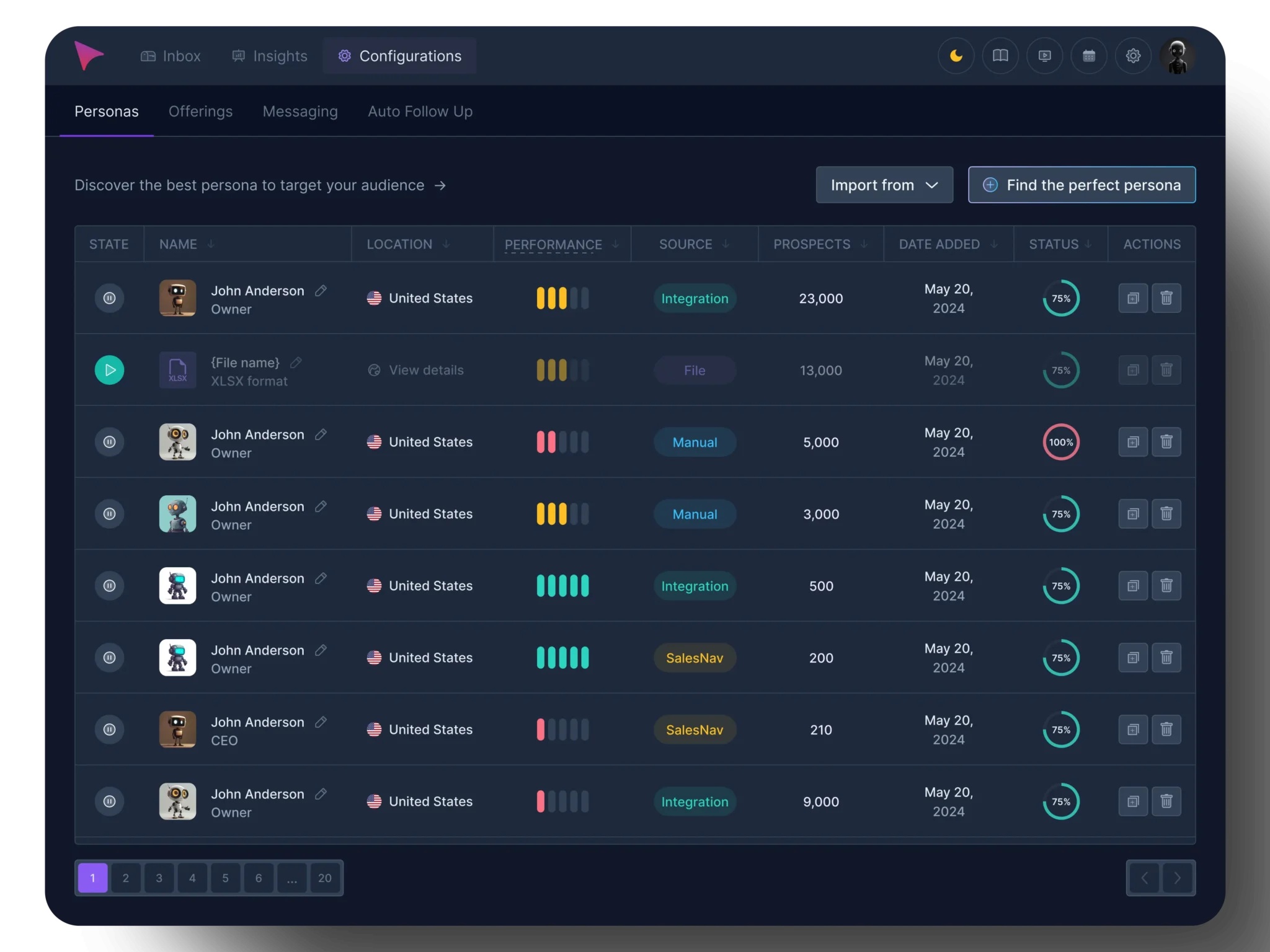
AnyBiz.io is an AI SDR platform built for the human-in-the-loop model. Ready to see it in action? Explore how AnyBiz can strengthen your B2B SaaS lead generation.
Conclusion
AI is now the baseline for competitive B2B SaaS lead generation rather than an edge that early adopters hold alone. The research points in a consistent direction. Sellers who partner with AI hit quota more often, personalization drives real revenue lift, and buyers increasingly start their journey inside AI answers rather than a search box.
A practical starting point is to pick one or two of these strategies, measure them against qualified-pipeline metrics rather than vanity numbers, and expand from what works.
Frequently asked questions
What is predictive lead scoring?
Predictive lead scoring uses machine learning to rank prospects by how likely they are to convert. It weighs signals such as engagement history, firmographics, technographic data, and behavior, then updates as new outcomes come in, so sales can focus on the accounts with the best odds.
Does AI actually improve email marketing?
Yes, when the fundamentals are in place. Litmus found that brands using dynamic, personalized content report a higher return than those that rarely do. That gain only materializes if your email reaches the inbox, which is why authenticated sending through SPF, DKIM, and DMARC, now required by Google and Yahoo, and proper domain warm-up come first.
How are AI chatbots useful for lead generation?
Chatbots engage visitors instantly at any hour, answer questions, qualify interest, and book meetings, which captures leads that would otherwise be lost to slow response times. They work best with one clear job, early contact capture, CRM integration, and a fast handoff to a human for complex conversations.
What is GEO, and why does it matter for SEO now?
Generative engine optimization is the practice of structuring content so AI systems cite and recommend your brand in their answers. It matters because buyer behavior moved. G2 found that 51% of B2B software buyers now start research in an AI chatbot, and Similarweb reported that zero-click searches rose from 56% to 69% after AI Overviews launched. GEO and traditional SEO reinforce each other rather than compete.
Is AI-driven lead generation only for large companies?
No. Businesses of any size can use AI for lead generation. Larger companies often use it to amplify existing programs, while smaller teams use it to compete with bigger players by automating research, scoring, and first-draft outreach that would otherwise require more headcount.
How do I start using AI-driven lead generation?
Identify the parts of your process that are repetitive or data-heavy, such as lead scoring or content personalization, then choose a tool that fits that specific need. Starting with one strategy, measuring it against qualified-pipeline metrics, and expanding from there tends to work better than adopting everything at once.