


Email marketing holds one of the highest returns of any channel available to B2B companies, yet the way most teams use it has drifted away from how buyers actually behave. Many organizations still run a broad, high-volume playbook, pushing the same message to as many contacts as possible and hoping a handful respond.
The numbers tell a sobering story. Average B2B cold email reply rates have fallen from roughly 8.5% in 2019 to about 3.4% entering 2026. In practical terms, close to 19 of every 20 cold emails now go unanswered.
The causes are structural. Inboxes are more crowded, spam filters have grown sharper, and a wave of low-effort, AI-generated outreach has trained buyers to dismiss anything that reads as generic. Inbox providers have raised the bar too.
Since February 2024, Google, Yahoo, and later Microsoft have enforced stricter rules for bulk senders, so campaigns that once slipped through now bounce before they reach a single inbox.
The channel itself remains strong. For every dollar spent, email still returns an average of about $36, a figure that has stayed remarkably steady even as paid advertising has grown more expensive. What separates results now is execution. On one side sit teams that treat email as a broadcast tool. On the other sit teams that treat it as a precise, data-driven system.
The reverse-targeting strategy: Why a smaller net yields higher-quality leads
Reverse-targeting inverts the usual logic of outbound. Instead of reaching for the widest possible audience, it concentrates effort on a smaller set of prospects who closely match your market and already show signs of being ready to engage.
The evidence for this shift is hard to dispute. Belkins analyzed 7.5 million cold emails across client campaigns in 2025 and found that lower send volumes consistently produced higher reply rates.
Hunter.io reached a similar conclusion after studying 11 million emails: tightly targeted campaigns outperformed broad blasts by a factor of 2.76, while depth of personalization lifted reply rates by 52%.
One agency documented a client whose reply rate climbed from 2% to 11% simply by narrowing its target from all SaaS companies to Series B SaaS firms of 50 to 200 employees running a specific CRM.
Broad outreach also carries a hidden cost. Sending to uninterested recipients raises spam complaints, and inbox providers now read those complaints as a direct penalty signal. Gmail asks senders to keep their spam complaint rate under 0.1% and starts enforcement once it reaches 0.3%. A single poorly targeted campaign can push a domain past that threshold and drag down the deliverability of every message that follows.
AnyBiz’s multichannel outreach capability
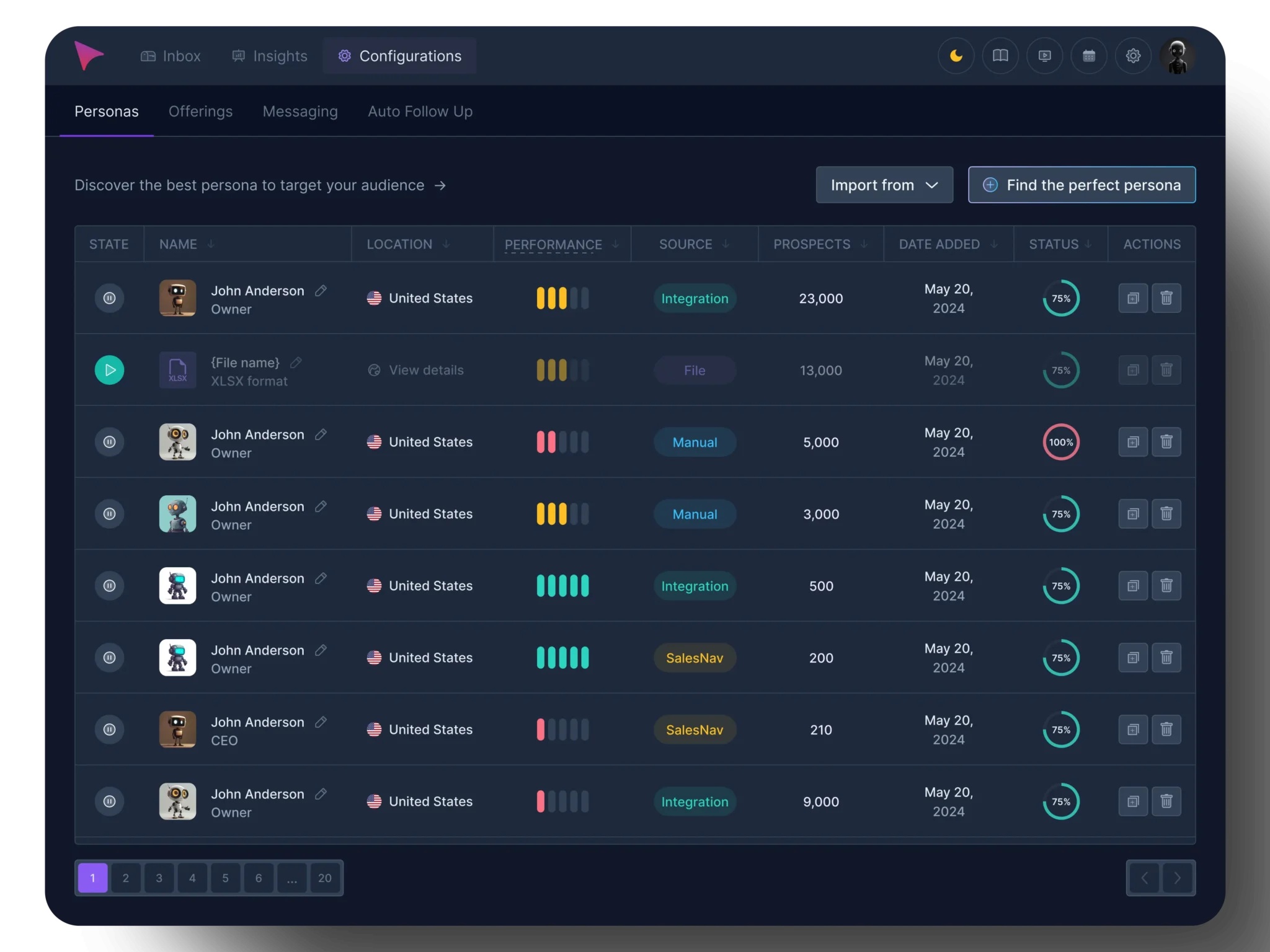
Email remains the single most effective marketing channel for most B2B teams, yet the strongest programs rarely stop there. Cold outreach that combines email with LinkedIn and phone can raise engagement compared with email alone. AnyBiz opens with email and expands across channels through its multichannel attribution capabilities as each conversation develops.
Email: Initial contact and follow-up
Email works well as the opening touch because it lets you build a relationship without crowding the prospect. The AnyBiz AI agent writes hyper-personalized messages based on prospect behavior and intent signals, such as a pricing request or an early buying cue.
Personalization at this depth now decides outcomes. Outreach that references something specific to the prospect drives open rates of 45% to 55%, against 20% to 25% for generic sends, according to Outreach’s 2025 benchmark data. After the first contact, the agent sends automated follow-ups and reinforces the message through custom landing pages it generates for each campaign.
Follow-up is where most campaigns quietly break down. HubSpot found that 48% of reps never follow up after an unanswered first email, and 44% stop after a single attempt. That habit leaves a pipeline on the table, because one follow-up alone can raise reply rates by 22%, and the majority of positive responses arrive only after several touches.
Segmentation and targeted communication
By reading prospect behavior, engagement, and firmographics, the AI agent groups leads so each message fits the audience receiving it. The payoff is well documented.
Segmented campaigns generate roughly 760% more revenue than undifferentiated broadcasts, and 78% of marketers named segmentation their most effective tactic in HubSpot’s 2025 State of Marketing report. Behavioral segmentation, which sorts prospects by what they do rather than who they are, has become the strongest single predictor of near-term conversion.
AI phone calls to advance deals
For high-intent prospects, a voice conversation can move a deal faster than any written message. AnyBiz’s AI voice agents place calls on behalf of your team using scripts that adapt in real time to what the prospect says.
Quality over quantity sits at the center of effective B2B lead generation. A small, focused group of high-fit leads drives more impact than a large pool of uninterested contacts. AnyBiz supports that approach by continually refining its understanding of your ideal leads, so campaigns keep reaching the prospects who matter most.
Looking beyond the ICP
The Ideal Customer Profile (ICP) helps businesses focus on prospects most likely to benefit from what they sell. It has a real drawback, though. Sticking rigidly to a predefined ICP can quietly close the door on valuable opportunities.
The risk of over-relying on the ICP
Targeting a specific customer type keeps messaging relevant, but it also narrows the field and excludes prospects who fail one ICP criterion yet could still become strong customers. The result is a kind of tunnel vision, where adjacent markets go unexplored. Widening the lens beyond a strict ICP recovers those overlooked leads and opens new revenue streams.
Strategies for diversifying lead generation
To capture leads outside a strict ICP, companies can target adjacent industries or test messaging variations that appeal to a broader audience. Alternative messaging often surfaces interest from prospects who would benefit from the product but do not fit the textbook mold. For teams building this foundation, our guide on creating a buyer persona with AI is a useful starting point.
How AnyBiz enables broader targeting
Through AI-driven targeting and a B2B prospect database, AnyBiz identifies buying signals and behaviors that go well beyond demographic or firmographic data. Rather than following a rigid ICP, its algorithms analyze behavioral patterns and interests, which helps you reach adjacent markets and experiment with broader targeting without losing relevance. You can test or refine your outreach as new insights emerge, keeping the flexibility to adapt.
The anti-funnel approach: Why a nonlinear path fits B2B buyers
Traditional B2B lead generation models follow a strict, linear funnel that moves prospects from awareness to interest to decision to action. The model reads well on a whiteboard. Real buying journeys rarely cooperate.
The evidence keeps pointing away from the tidy funnel. According to 6sense’s 2025 Buyer Experience research, the average B2B buying cycle compressed from 11.3 months to 10.1 months in a single year as buyers ran more of their own research, and they now make first contact with a vendor at about 61% of the journey, down from 69% a year earlier.
By the time a prospect raises a hand, they have already moved through most of a path you never saw. A rigid funnel assumes a sequence that the buyer has, in many cases, already skipped.
The anti-funnel approach responds to that reality. It replaces fixed stages with a flexible path and reaches prospects through relevant, personalized touchpoints wherever they happen to be. For email specifically, this lets each lead engage on their own terms instead of being pushed through a predetermined sequence.
The no-funnel concept: Tailored engagement over linear progression
In a no-funnel approach, the goal moves from advancing prospects through stages to creating genuinely useful interactions every time they engage with your brand. Opening an email does not automatically mean a prospect is ready for an interest-stage pitch. Each engagement instead becomes a chance to deepen the relationship. Personalized touchpoints anchor the method, from customized emails to LinkedIn messages to AI-powered calls that adapt to the prospect’s tone and level of interest.
How the anti-funnel approach drives qualified leads
Stepping away from a rigid funnel can feel like a gamble, since it diverges from a method that may have worked before. The upside is that it captures qualified leads much earlier in the engagement cycle. Prospects who do not progress in a straight line often get labeled unqualified even when they are a strong fit. By delivering value and personalized content, the anti-funnel approach lets those prospects move through the journey at their own pace, which raises the odds of converting them.
How AnyBiz supports the anti-funnel model
AnyBiz is well suited to an anti-funnel approach through AI-driven personalization and multi-channel engagement. By combining data insights with targeted messaging across channels, it engages leads at different stages, recognizing when to reach out and what content to share based on the lead’s current needs. Instead of forcing prospects into a fixed sequence, AnyBiz meets them where they are and turns interest into action in a way that feels natural.
Psychological triggers that drive conversion
Understanding why leads engage and convert is essential in B2B email marketing. Content and design matter, but subtle psychological triggers often make the larger difference. Principles such as reciprocity, social proof, and authority build the trust and credibility that lead to conversions.
Reciprocity: Give value before you ask
Give value first. Sharing a helpful guide or an original industry insight establishes goodwill and creates a sense of reciprocity.
Engage without pressure. Offering resources without pushing for an immediate sale opens a natural path to future conversations.
Examples in practice. A downloadable report, a free tool, or genuine expert advice in an email builds positive sentiment and makes a lead more likely to respond.
Social proof: Show evidence of success
People tend to follow the lead of others, and that instinct is powerful in B2B. Prospects engage more readily when they see respected companies or peers already benefiting from your product. Testimonials, case studies, and recognizable client logos reassure a lead that considering your offer is a safe, sensible choice. Used consistently, social proof reinforces credibility and positions your company as a trusted partner.
Authority: Demonstrate genuine expertise
Share thought leadership. Relevant research, data, and informed commentary position your brand as an expert and make leads more receptive.
Use clear, credible information. Skip the jargon and focus on content that shows real understanding of the challenges your buyers face.
Borrow authority by association. Partnerships with reputable companies, along with any awards or certifications, add a further layer of credibility.
Why lead psychology matters in B2B
Applying these triggers well requires understanding what motivates a B2B buyer. Unlike most B2C customers, B2B leads work through longer cycles and need more validation before deciding. This is measurable: McKinsey found that 71% of buyers expect personalized outreach, yet fewer than 20% of sales reps personalize consistently, mostly for lack of time. Recognizing that a lead is driven by a need for value or reassurance helps you write messages that speak to those motivations and lift engagement.
Data-driven insights: The new foundation of B2B email lead generation
Real-time data and predictive analytics increasingly decide which programs generate quality leads and which stall. Fixed, one-size approaches cannot keep up with individual behavior or shifting market conditions. Real-time analytics let teams adjust instantly and tailor outreach to what a lead needs in the moment.
The scale of the difference is striking: automated, behavior-triggered emails generate about 16 times more revenue per send than manual campaigns, roughly $2.87 versus $0.18, according to Omnisend, and behavioral trigger emails produce around 10 times the revenue of standard sends.
How real-time analytics sharpen outreach
With real-time insight, marketers can:
- Track engagement trends. Monitor how prospects interact so you learn what resonates. With Apple Mail Privacy Protection now affecting a majority of Apple Mail users and inflating open rates, click and reply data have become the more reliable read on real interest.
- Optimize timing. Identify when a given audience is most responsive and send accordingly. Local-time send optimization consistently improves engagement.
- Adjust content on the fly. Adapt messaging based on live engagement, keeping each campaign relevant as behavior changes.
Predictive analytics and proactive lead generation
Predictive analytics goes further by anticipating what a lead will do next, which lets teams act before intent cools:
- Personalized content. Surface the topics that interest each lead so outreach lands with more weight.
- Optimized timing and channel. Predict the best moment and platform to reach each lead, which raises response rates across the journey.
Signal-based outreach shows what this makes possible. Campaigns that fire on real buying signals achieve reply rates of 15% to 25%, roughly five times the 3% to 5% industry average for standard cold email, based on data from Autobound, Instantly, and Belkins.
How AnyBiz turns data into pipeline
AnyBiz applies real-time and predictive analytics to keep refining B2B email lead generation. By reading each prospect’s behavior, it adjusts timing, content, and channel to build an outreach strategy that adapts continuously. The result is higher-quality lead generation with more precision and less waste.
The role of AI in reinventing email lead generation
Artificial intelligence has moved from experiment to infrastructure in B2B sales. As of the first quarter of 2026, 41% of enterprise B2B teams had an AI-powered sales development representative in production, up from 12% a year earlier, and Salesforce reported that 81% of sales teams were experimenting with or had fully implemented AI. Teams using AI are meaningfully more likely to grow revenue: 83% of AI-adopting teams saw revenue growth in Salesforce’s data, against 66% of teams without it.
The mechanism is well understood. AI reads engagement patterns and tailors messaging to each lead’s needs, which lifts both open and reply rates. AI-generated personalized subject lines produce open rates around 26% higher than generic ones, and campaigns run with AI have shown 57% higher open rates and 82% more responses than non-AI campaigns in benchmark tests. AI-powered platforms like AnyBiz make that level of personalization workable across email and other channels, so a small team can operate at a scale that once required many more people.
Conclusion
Rigid, high-volume B2B email tactics no longer hold a modern buyer’s attention, and the falling reply rates across the industry make that plain. The strategies covered here point in a different direction: reverse-targeting to reach fewer, better-fit prospects; an anti-funnel model that respects how buyers actually move; psychological triggers that build trust; and a data-driven foundation that adapts in real time.
AnyBiz was built to make these approaches practical at scale, combining AI personalization, multi-channel outreach, and continuous optimization in one platform. To see how it fits your pipeline, request a demo.
FAQ
What is a realistic cold email reply rate for B2B in 2026?
Platform-wide averages sit around 3% to 5%, and Instantly’s 2026 benchmark puts the figure near 3.4%. A reply rate above 5% is considered good, and 10% or higher is strong. Top performers reach 15% to 25% through tight targeting, signal-based personalization, and disciplined follow-up. If your rate sits below 1%, the problem is usually deliverability, targeting, or copy rather than the channel itself.
Why did my emails suddenly stop reaching inboxes?
Since February 2024, Google and Yahoo have required bulk senders to authenticate with SPF, DKIM, and DMARC, keep their spam complaint rate below 0.3%, and offer one-click unsubscribe. In November 2025, Gmail moved from temporary delays to permanent rejections for non-compliant mail, and Microsoft began rejecting non-compliant messages in May 2025. Compliant senders average roughly 89% inbox placement, while non-compliant senders can see a large share of mail diverted to spam. Confirm your authentication records and monitor your spam rate first.
Does personalization actually improve results, or is it just a best practice?
It is measurable. Personalization beyond a first name, referencing something specific to the prospect, can roughly double reply rates, and outreach tied to multiple relevant data points converts at about twice the rate of lightly personalized messages. Signal-based outreach that fires on real buying triggers reaches 15% to 25% reply rates, several times the industry average.
How many follow-ups should a cold email sequence include?
Most positive responses arrive after the first message, so a sequence of two to four touches spaced a few days apart works well for many B2B teams. A single follow-up alone can raise reply rates by 22%. The larger issue is that many reps stop too early: HubSpot found that 48% never follow up at all and 44% quit after one attempt.
How long should a cold email be?
Shorter messages perform best in current data. Emails of roughly 50 to 125 words tend to earn the highest reply rates, and a clear, single call to action outperforms a message crowded with links or asks. Plain-text emails usually beat heavily designed HTML in cold outreach.
Can AI handle lead generation without hurting quality?
Used well, yes. AI-run campaigns have shown 57% higher open rates and 82% more responses than non-AI campaigns in benchmark tests, largely because AI makes deep personalization workable at scale. The strongest results come from a hybrid model, where AI handles research, first-touch personalization, and timing while people focus on relationship-building and complex conversations. Low-effort, fully automated content that reads as generic tends to increase unsubscribes, so a human quality check still matters.
How do I measure whether my email lead generation is working?
Track reply rate and positive reply rate rather than leaning on open rate, which Apple Mail Privacy Protection has made unreliable by auto-loading tracking pixels. Follow those through to meetings booked and pipeline generated. Connecting email activity to revenue, rather than to engagement proxies, is the shift that separates top-performing programs from the rest.