


An AI sales rep answers a prospect in seconds, at two in the morning, in a dozen languages, and never takes a day off. On raw speed and cost, the contest looks settled before it starts.
Look closer, though. More than half of sellers now use AI agents, and nearly 9 in 10 plan to by 2027, according to Salesforce, and the same report is just as clear about why: reps want the help so they can spend more time with customers, not step out of the process.
That is the real shape of the AI SDR vs human SDR question: What each side is built to do well?
The teams pulling ahead this year stopped arguing about which side is better. They worked out exactly what to hand the machine and what to keep human. Here is what the numbers actually say.
Start with where the money actually goes
The honest case for AI outbound starts with a workload problem. Salesforce research puts sales reps at roughly 70 percent of their week on work that is not selling: research, list building, data entry, and follow-up logistics.
McKinsey estimates that generative AI could eventually automate the tasks that consume up to 80 percent of a seller’s day, and HubSpot reports that most reps already claw back one to five hours a week with AI. That first win has nothing to do with replacement. It is recovered time.
The cost math is where it gets sharper. In the United States, the median SDR base salary sits around $60,000, and on-target earnings land near $85,000 once commission is counted, per RepVue.
Layer on benefits and payroll taxes, which add roughly 30% on top of pay, then the sales tech stack, recruiting fees, and three to six months of ramp at partial output, and a single fully loaded seat runs closer to $110,000 to $150,000 a year before that rep books a meeting.
Turnover makes that math worse. SDR attrition runs 30 to 39% a year, average tenure is 14 to 18 months, and more than 1 in 10 teams churn over half their reps annually, according to SOMAmetrics. Each replacement is estimated to cost 50 to 200% of the rep’s salary once you count lost productivity, recruiting, and onboarding. So you are not buying one ramp. You are buying a fresh one every year or two.
An AI outbound platform runs on a flat subscription, not a salary. AnyBiz starts at $497 a month for an AI SDR working the email channel, and the recommended plan runs $998 a month to add calls and LinkedIn on top, with a custom tier for high-volume teams. It produces from day one, with no ramp and no turnover to reset. For a founder weighing a first SDR against software, that gap is the decision.
AI SDR vs human SDR, side by side
Strengths and weaknesses sort cleanly once you stop comparing headcount totals and start comparing tasks.
|
Dimension |
AI SDR |
Human SDR |
|---|---|---|
|
Cost |
Fraction of one salary, scales flat |
Full salary, benefits, tooling, plus ramp |
|
First response |
Seconds, any hour |
Minutes to hours, business hours only |
|
Coverage |
24/7/365 |
About 40 hours a week |
|
Languages |
Dozens |
One or two |
|
Outreach volume |
Effectively unlimited |
60 to 100 touches a day |
|
Personalization at scale |
Consistent and research-driven |
High but uneven |
|
Relationship building |
Weak |
Strong |
|
Complex objections and closing |
Limited |
Strong |
AI dominates the mechanical, high volume, always-on work. Humans own the parts of a deal that run on judgment and trust. Neither is about to win the other’s column.
Where AI wins, and where it falls short
AI’s edge is real and it is narrow: speed, coverage, volume, and consistency, applied across email, LinkedIn, and calling at once. The inbound lead that arrives at 6 p.m. on a Saturday, when no human on your team is staffed to answer, is exactly the gap an AI rep closes.
That speed is not a vanity metric. Harvard Business Review found that contacting a lead within five minutes makes it 21 times more likely to qualify than waiting 30 minutes. Multiply that across every after-hours form fill and the recovered pipeline adds up fast.
The trap is treating volume as the goal. The inbox is getting harder, not easier. Salesforce found that 73% of B2B buyers now actively avoid sellers who send irrelevant outreach, and Gartner expects 30% of outbound messages from large organizations to be machine-generated.
So the number that matters is not replies. It is meetings held and pipelines created. That is also where the human advantage reappears: the buyer-confidence gap is a closing-stage signal, not a top-of-funnel one.
The funnel math backs that up. Push raw volume, and AI can run 10 to 50 times the touches a person can manage, depending on the channel.
Which model fits your situation
The right split depends less on the technology than on the deal you are running. Four questions sort it out fast.
- What is your average deal size? Under roughly $25,000 in annual contract value, an AI-led top of the funnel usually wins, because the cost of human prospecting eats the margin. Above $50,000, the higher cost of a person in the loop tends to earn itself back.
- How complex is the buying process? A single decision maker rewards speed and volume. A committee of five or more stakeholders rewards the multi-threading and judgment that only a person brings.
- How long is your sales cycle? Short cycles reward fast, consistent first touches. Cycles that run for months reward relationship equity built over time, which is human work.
- How sensitive is your brand? If your buyers are senior executives who expect a premium first impression, undifferentiated AI outreach carries a real cost. If a fast response matters more than polish, AI clears the bar.
Read your answers together, and most teams land somewhere in the middle, which is exactly why the hybrid keeps winning. The split below is the version that holds up.
The stack that wins, especially if you have no SDR team
The setup that outperforms is not AI or human. It is a clean handoff between them. AI takes the top of the funnel: research, list building, first touch, sequencing, qualification at scale, and the patient follow-up that humans let slide.
The human takes the moment of trust: discovery, nuance, objection handling, and the close.
What makes that handoff work is knowing exactly what triggers it. A lead should move from AI to a person on any real buying signal: a positive or negative reply that needs a human read, a question about pricing or implementation, a meeting request, or a lead score that crosses your threshold.
The catch is speed on the other side. AI’s five-minute edge evaporates if the human takes two days to follow up, so treat a handed-off lead like hot inbound and answer it the same day.
Define those triggers and that response time in writing before you turn anything on, then watch meeting quality and pipeline conversion, not raw send volume, to tell you whether the split is working.
The ingredient most tools quietly skip is guidance. AI value does not appear on its own. It follows tight, well-run deployments with someone steering them. Teams that actively test persona, offer, and messaging in the first two to three months reach the right combination faster and hold better results than the set-and-forget crowd.
Build the front end before you hire for it
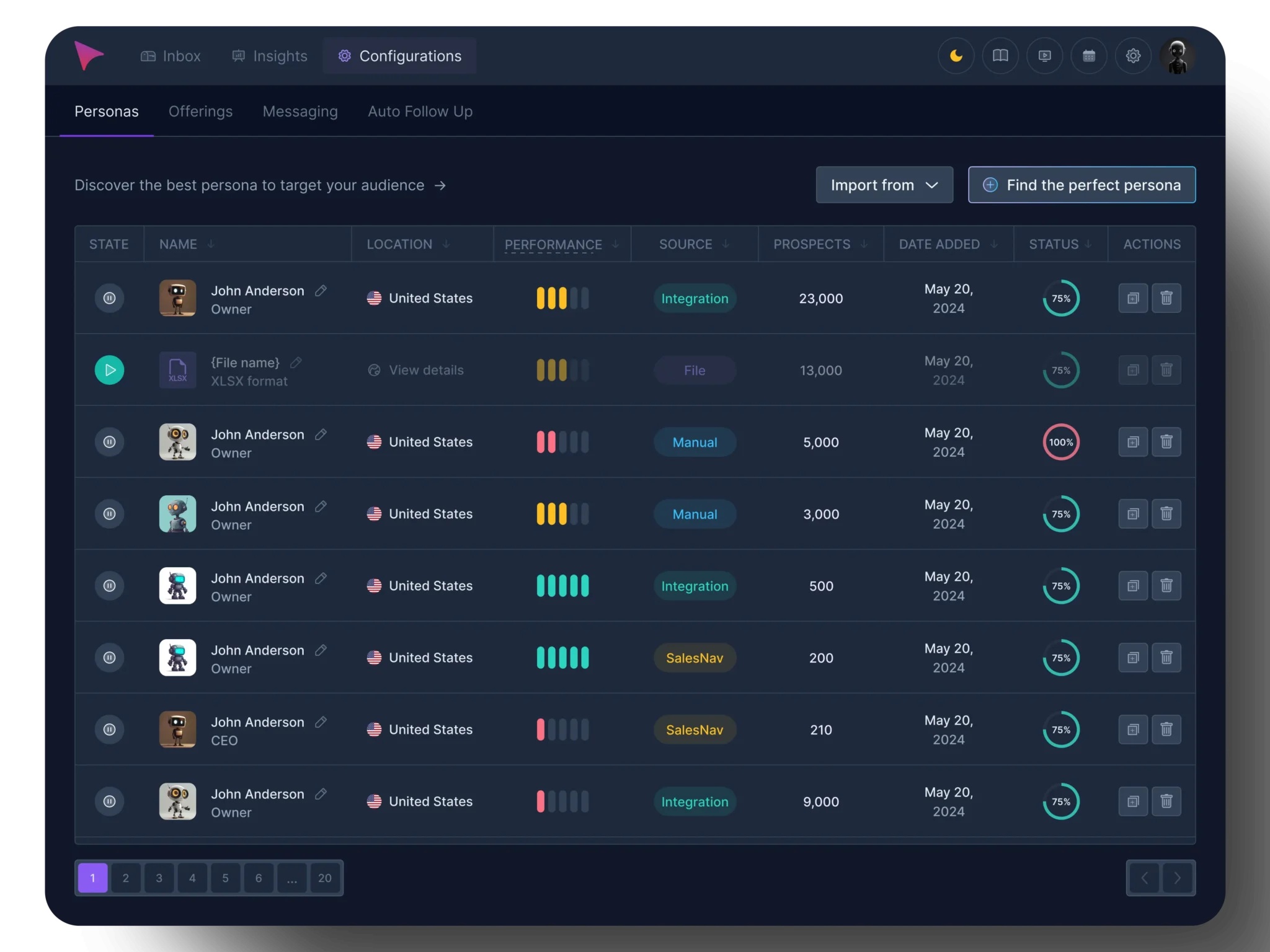
AnyBiz runs the AI layer of a hybrid outbound motion: email outreach, AI calling, LinkedIn outreach, and the deliverability infrastructure that keeps all of it landing, backed by hands-on strategy to dial in your persona and offer.
Book a demo and see what your pipeline looks like when the top of the funnel runs itself.
FAQ
Can an AI SDR fully replace a human SDR?
For high-volume outreach into smaller, simpler accounts, an AI SDR can run most of the top of the funnel on its own. For complex, high-value deals with several stakeholders, full replacement usually costs you in meeting quality and trust. Most teams get more from pairing the two than from picking one.
How much does an AI SDR cost compared to a human SDR?
A fully loaded sales development hire carries salary, commission, benefits, tooling, and a manager’s time, plus months of ramp before the first meeting. An AI platform runs at a fraction of a single seat and produces from the first week. Judge the spend on pipeline created, though, not on volume sent, since cost per touch is not the same as cost per deal that closes.
Do AI SDRs hurt email deliverability?
They can, if you open the volume valve before the sending infrastructure is ready. Cold domains with no warm-up, thin DNS records, and a weak sender reputation push even strong copy into spam. An AI layer that manages warm-up, authentication, and reputation is what keeps high volume landing in the inbox.
What does a hybrid SDR setup look like?
AI owns the mechanical top of the funnel: research, list building, first touch, sequencing, and the patient follow-up that humans let slide. The human owns the moment of trust: discovery, objection handling, and the close. The handoff between them is the whole game.