


Key takeaways:
- Cold calling remains a key source of revenue. Despite the rise of email, LinkedIn, and automation, cold calls continue to generate a significant share of qualified leads.
- The 2.3% average conversion rate is misleading without context. That industry benchmark reflects unfocused, high‑volume calling. Teams using clean data, proper targeting, and consistent follow‑ups routinely achieve conversion rates two to three times higher.
- Success varies widely by industry, timing, and persistence. Conversion rates depend heavily on who you call, when you call, and how often you follow up. Three attempts account for most real conversations, and calling outside optimal time windows significantly lowers results.
- Buyer resistance isn’t the main problem. Many prospects answer unknown numbers and are open to cold meetings. The real differentiator is message relevance, call quality, and reaching actual decision‑makers.
- AI is becoming a competitive advantage, not a nice‑to‑have. From lead prioritization and call timing to coaching and admin automation, AI is helping sales teams spend more time selling and make smarter decisions on every dial.
In an era defined by email automation, LinkedIn outreach, and AI-driven marketing, cold calling refuses to fade. In fact, according to Orum’s State of Sales Development report, 51% of leads still come directly from cold calls and more than 80% of sales directors say the phone remains essential to outbound lead generation. Yet for many sales teams, cold calling feels like a mystery: they know it works, but they’re unsure exactly how well, and why results vary so widely.
The answer lies in understanding the numbers behind the practice. Cold calling conversion rates shift based on industry, timing, follow-up persistence, data quality, and increasingly, the technology powering the calls.
This article breaks down the latest benchmarks, key statistics, and the growing role of AI, so your team can approach every dial with a clearer strategy.
Current Cold Calling Conversion Rates
The average cold calling success rate sits at approximately 2.3%, according to Cognism’s 2025 State of Cold Calling Report, which analyzed over 204,000 cold calls and 27,000+ conversations. That means roughly 2 to 3 out of every 100 calls result in a meaningful conversation or booked meeting. A figure that, in isolation, sounds discouraging.
But context matters. When teams use high-quality data, targeted prospect lists, and optimized outreach strategies, that number climbs significantly. Cognism found that teams leveraging their own platform achieved a 6.7% cold call success rate for booked meetings, nearly three times the industry average. The baseline 2.3% reflects underprepared, untargeted calling at scale.
In addition, 32% of prospects answer calls from companies they haven’t previously spoken with (RAIN Group, Top Performance in Sales Prospecting), and a striking 82% of buyers say they accept meetings at least occasionally from sellers who reach out cold. These figures suggest that the barrier to cold calling success is less about buyer resistance and more about the quality of the approach.
Cold Calling Success Rates by Industry
Conversion rates vary meaningfully across sectors. The following estimates are drawn from industry research and sales benchmarking studies:
- Financial Services typically sees higher conversion rates, in the 3–5% range. Personal trust and relationship-building are essential in financial decisions, making direct phone contact particularly well-suited to this sector.
- Real Estate performs similarly, with success rates also around 3–5%. The high-stakes, personal nature of property transactions makes prospects more receptive to direct conversations.
- Software and Technology lands around 2–4%. Complex products and long decision cycles mean prospects are often open to exploratory calls that can clarify how a solution fits their needs.
- Healthcare shows one of the wider ranges, from 2–6%, depending heavily on the type of offering (device, software, services) and the regulatory environment shaping buying decisions.
- Business Services averages 2–3%, with stronger conversion when reps can demonstrate clear ROI quickly on the call.
- Insurance performs at a moderate-to-strong 2–4%, benefiting from the same trust-based dynamics that drive financial services results.
- Manufacturing and Hospitality & Travel both tend to cluster around 2–3%, with success most dependent on precise targeting and timing.
- Consumer Goods and Retail generally sit at the lower end, around 1–2%, where market saturation and transactional products reduce the need for consultative conversations.
- Education ranges from 1–3%, with success rates rising sharply when calls are directed at actual decision-makers rather than front-line staff.
Key Cold Calling Statistics for 2026
- Average call duration is rising. According to Cognism’s 2025 State of Cold Calling Report, the average cold call now lasts 93 seconds, up from 83 seconds in previous years, suggesting that conversations are becoming slightly more engaging.
- Three attempts is the sweet spot. On average, connecting with a lead takes three cold call attempts, and by the third call, 93% of all conversations occur. Critically, over 98% of conversations happen by the fifth call, making additional dials largely ineffective and a waste of resources (Cognism, 2025 State of Cold Calling Report).
- Callbacks are a real opportunity. You have approximately a 26.85% chance of successfully reaching a prospect on a callback, making voicemail strategy and follow-through critical components of any cold calling program (Cognism, 2025 State of Cold Calling Report).
- C-suite executives have conflicting behaviors. While 90% of C-suite executives report they don’t respond to cold calls or email blasts (InsideView), the RAIN Group research shows that 57% of B2B C-level executives actually prefer being contacted by phone, particularly early in the buying process.
- Tuesday is the best day to book meetings. Cognism’s 2025 analysis found that Tuesdays yield the highest success rate for booking meetings from cold calls. Wednesdays and Thursdays also perform well. Fridays, while poor for booking, tend to be more effective for relationship-building calls.
- The best calling windows are mid-morning and early afternoon. The most productive time blocks are 10–11 a.m. and 2–3 p.m., while calls placed between 7–9 a.m., during the noon lunch hour, and around the 5 p.m. commute consistently underperform (Cognism, 2025).
- AI is saving significant time. HubSpot’s 2024 Sales Trend Report found that AI tools save sales reps an average of 2 hours per day, and 83% of sales teams that incorporate AI into their workflows report revenue growth (Salesforce, State of Sales, Sixth Edition). Additionally, 47% of sales teams now use AI specifically for call coaching.
Enhancing Conversion Rates with AI
Artificial intelligence is reshaping how sales teams approach cold calling; AI tools now analyze vast datasets to identify which leads are most likely to convert, predict the optimal time to call, and flag patterns in successful vs. unsuccessful conversations that human reviewers would miss.
One of the most practical applications is script optimization. By processing historical call data, customer sentiment signals, and conversion outcomes, AI can recommend adjustments to word choice, tone, and question sequencing that meaningfully improve engagement rates.
AI also handles the logistical load that eats into selling time. HubSpot found that sales development reps spend just two hours a day actively selling, with nearly an hour lost to administrative tasks. AI-powered CRM tools automate dialing schedules, log call outcomes, prioritize follow-ups, and verify phone numbers before a rep ever picks up the receiver, freeing reps to focus on the conversations themselves.
Benefits of Automating Cold Calling with AI
- Increased Efficiency. AI automates routine tasks like dialing and scheduling, freeing up sales teams to focus on engaging effectively with prospects.
- Scalability. AI allows businesses to handle more calls without proportionally increasing staff, facilitating easy scaling of operations.
- Cost-Effectiveness. Automation reduces the cost per call and optimizes resource allocation, leading to lower customer acquisition costs.
- Higher Conversion Rates. AI enhances conversion by providing sales reps with real-time insights and personalized conversation strategies based on individual prospect data.
- Enhanced Customer Interactions. AI tools analyze customer responses and adjust approaches in real time, ensuring interactions are more personalized and potentially more satisfying for the customer.
Eager to learn more? Our related article has all the answers: How AI Cold Calling is Better Than Human: Tools + Tips.
Introducing AnyBiz: AI-Driven Lead Generation
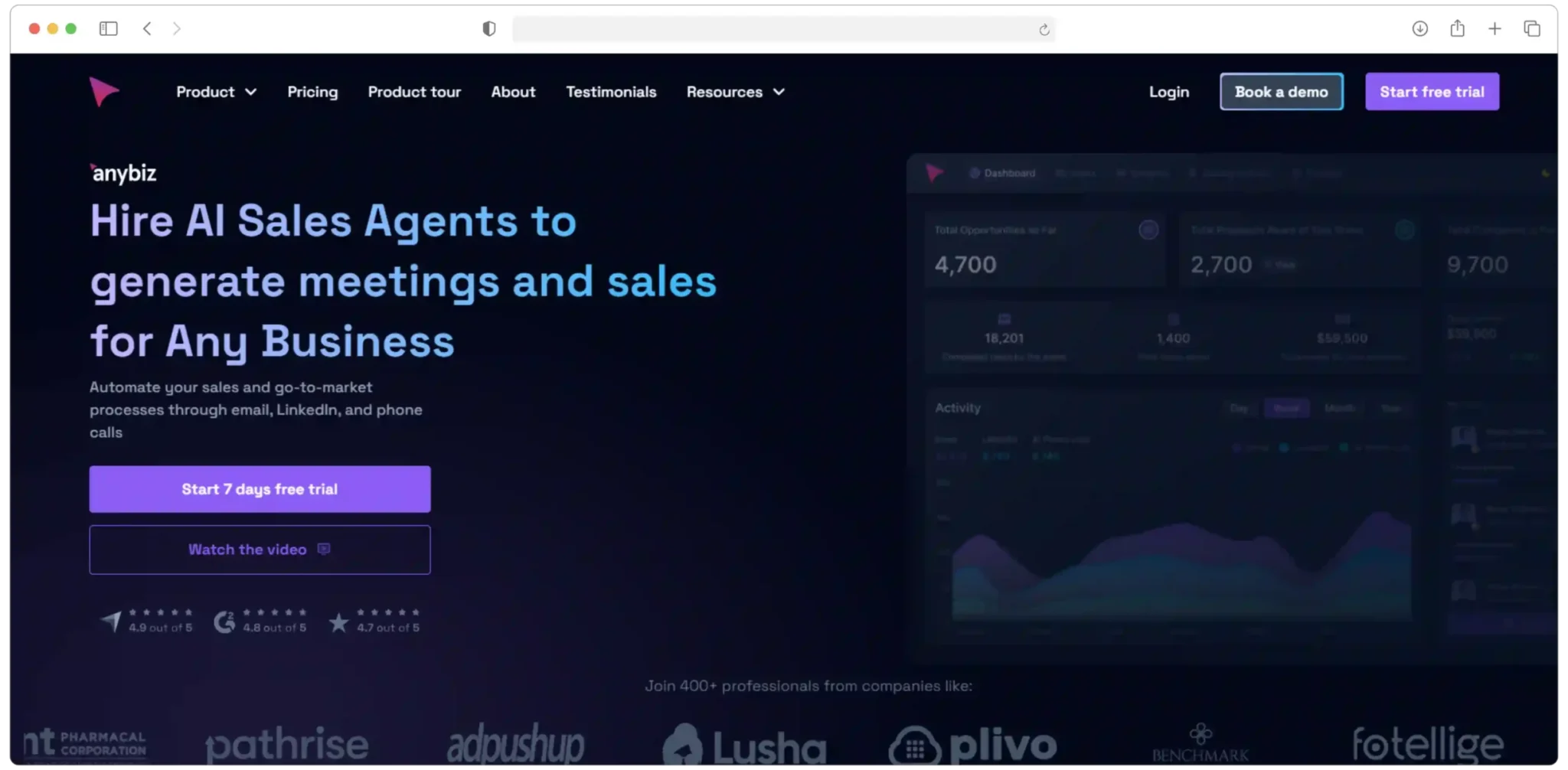
AnyBiz is an AI-powered B2B lead generation platform designed to automate and optimize outbound sales operations. Rather than relying on traditional Sales Development Representatives (SDRs), AnyBiz deploys AI sales agents that run continuously, managing personalized outreach sequences, handling follow-up communications, and engaging prospects across multiple channels including email and LinkedIn.
The platform analyzes over 10,000 data points per hour to inform strategic outreach decisions, integrates with CRM tools like HubSpot and scheduling platforms like Calendly, and adapts messaging dynamically based on prospect behavior and engagement signals.
Why Choose AnyBiz for Lead Generation?
- Completely Automated System. AnyBiz handles jobs that in the past needed human involvement by using state-of-the-art AI. Everything from creating customized outreach sequences to overseeing follow-up correspondence is done with efficiency and effectiveness in mind. This automation frees up companies to concentrate on growth and strategy while the AI takes care of daily interaction.
- Continuous Operation. AnyBiz AI sales agents work nonstop, around-the-clock, unlike human agents, so your company is always up, always responsive, and always in time with the time zones of your prospects. The operating around-the-clock greatly raises the chances of interaction and possible lead conversion.
- Strategic Decision-Making. The AnyBiz platform is a proactive member of your team rather than only a reactive one. For well-informed, strategic decisions that exactly match your company objectives. Every outreach is made to increase interaction and effectively advance prospects through the sales funnel.
- Multi-Channel Engagement. The AI agents approach prospects with a multi-channel strategy. Every contact is tailored to the interests and actions of the prospect, guaranteeing a greater rate of reaction and involvement.
AnyBiz AI Phone Calls: Automated Outreach at Scale
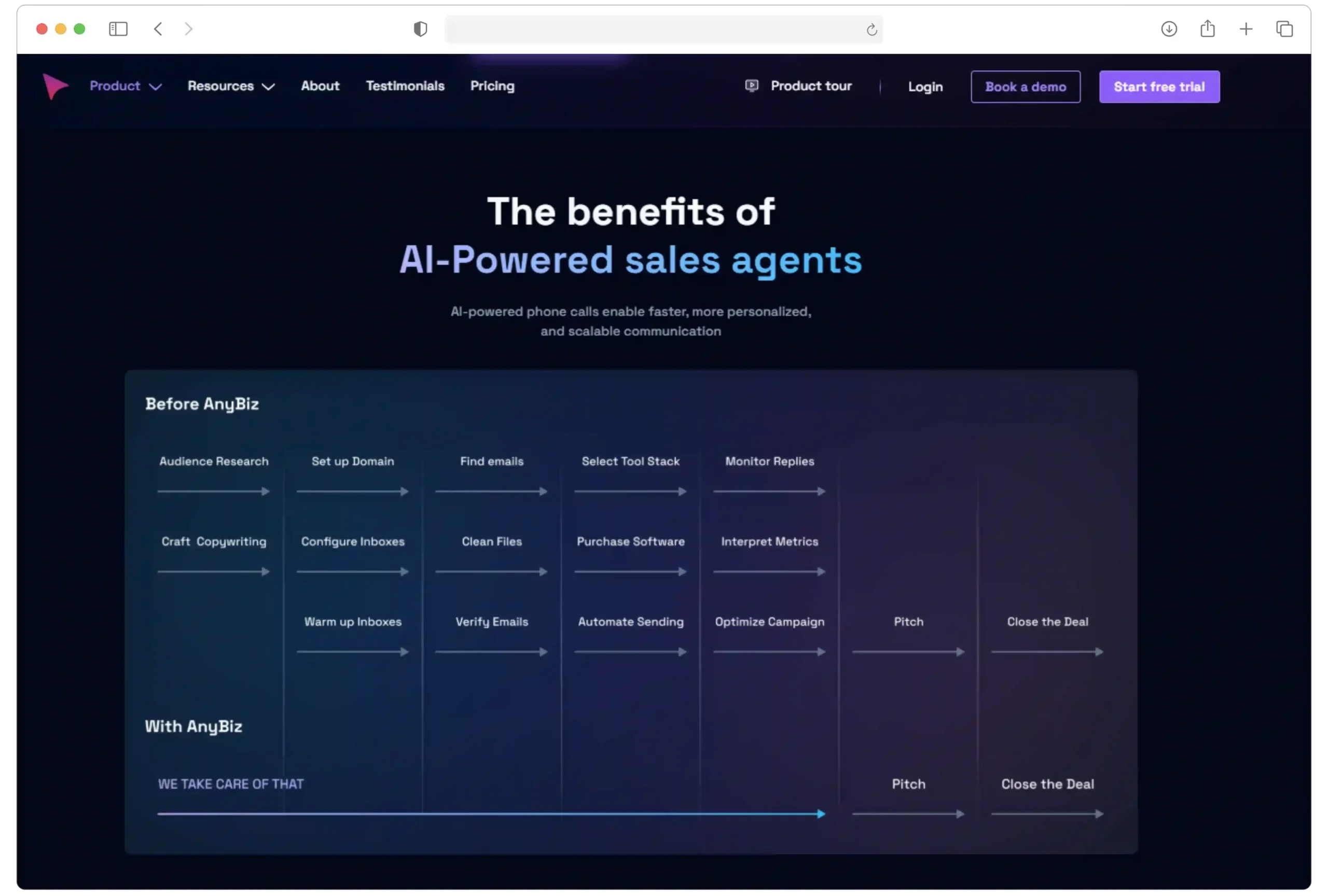
AnyBiz takes its AI-driven sales platform a step further with a dedicated AI Phone Calls feature, designed to eliminate the back-and-forth of email outreach and connect directly with prospects in real time.
Key capabilities include optimal call timing powered by machine learning (to maximize connection rates), automatic call transcription for team review and training, multi-language support for global outreach, and customizable call goals adaptable to different use cases such as sales prospecting, local business outreach, or enterprise pipelines.
For sales teams looking to add phones as a high-volume, intelligent channel, without adding headcount, AnyBiz AI Phone Calls brings the same data-driven personalization that powers its email and LinkedIn outreach to every conversation on the line.
Schedule a demo to see the platform in action.
Conclusion
Cold calling remains one of the most effective ways to generate outbound sales. However, the gap between average representatives and top performers has widened over the years. This difference usually comes down to how well teams use data and technology and how consistent they are with follow-ups.
The industry average conversion rate of 2.3% doesn’t tell the whole story. Representatives who are prepared, work with clean data, and follow through consistently often convert at two or three times that rate.
At its core, the job hasn’t changed. It’s still about talking to the right person at the right moment and providing them with information that matters, while also not giving up after one call. What has changed is how precisely we can accomplish all that. Teams that use data, CRM insights, AI and conversation intelligence are making smarter decisions at every stage.
FAQ
- Is cold calling still effective in 2026?
Yes. Despite the growth of email automation and social selling, cold calling continues to play a major role in outbound sales. Industry data shows that a significant percentage of qualified leads still originate from phone conversations, especially when calls are well‑timed and properly targeted.
- What is a “good” cold calling conversion rate today?
The industry average sits around 2.3%, but that number doesn’t reflect what’s possible. Teams using high‑quality data, clear targeting, and consistent follow‑ups often see conversion rates two to three times higher than the average.
- Why do cold calling results vary so much between teams?
Results depend heavily on factors like data quality, industry, call timing, message relevance, and follow‑up discipline. Teams that rely purely on volume tend to underperform compared to those using data and technology to guide their outreach.
- How many call attempts should an SDR make per prospect?
Research shows that most meaningful conversations happen within the first three call attempts, and nearly all successful connections occur by the fifth. Beyond that point, the return drops sharply, making additional attempts inefficient.
- How is AI changing cold calling success rates?
AI is helping sales teams make better decisions at every stage of the process. From identifying the best leads and call times to optimizing scripts and automating admin work, AI allows reps to spend more time selling and approach each call with better context.