


TL;DR
|
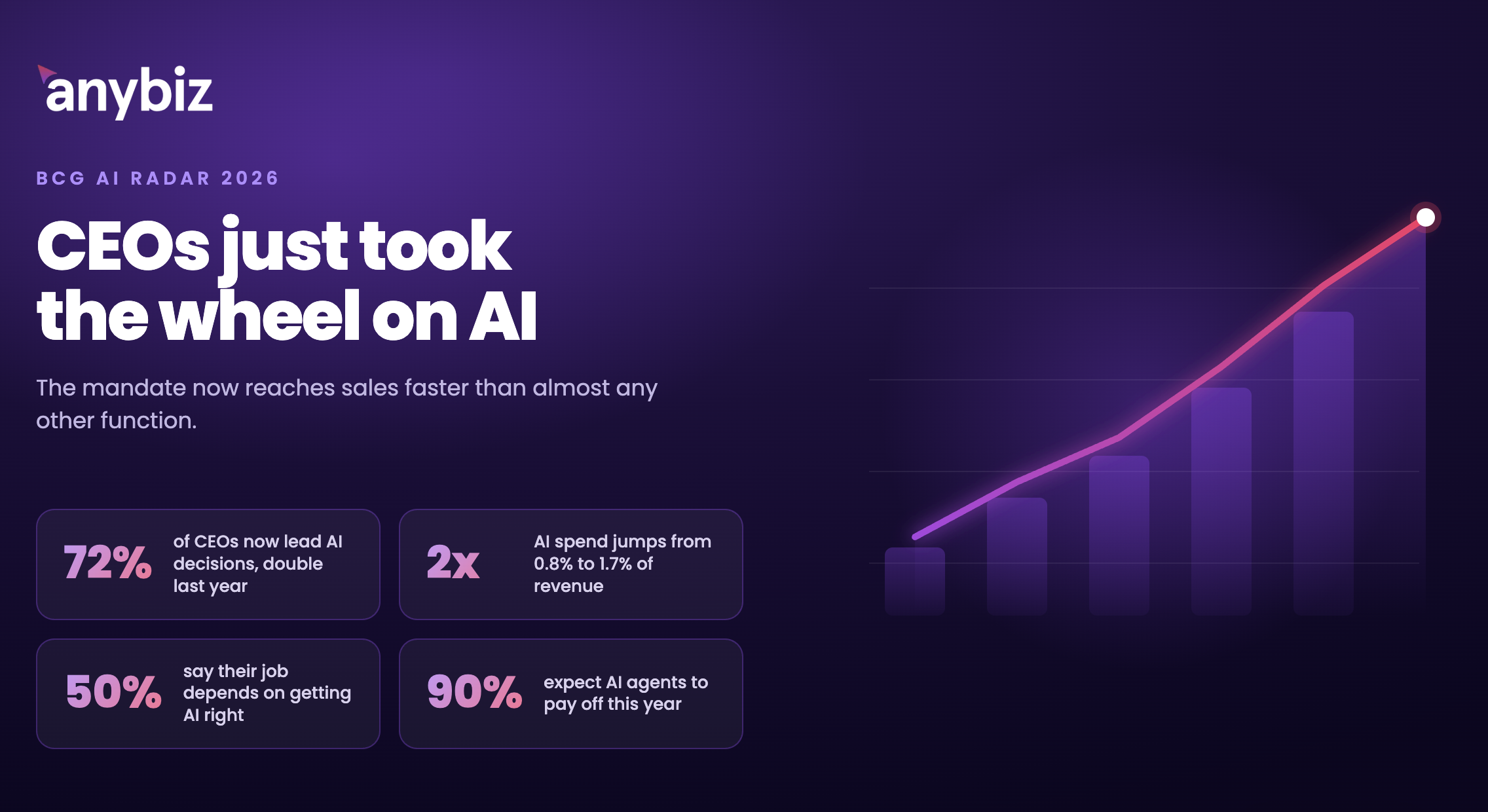
In January 2026, the Boston Consulting Group reported that 72% of CEOs now call themselves the main decision-maker on artificial intelligence at their company, double the share from a year earlier. The same companies plan to roughly double their AI spending this year, moving from 0.8% to about 1.7% of revenue.
That pressure travels downhill to sales faster than to almost any other function. Half of the CEOs in the same survey said their job depends on getting AI right, and outbound is one of the first places they look for evidence.
If you lead a sales team, you are now expected to run AI SDRs next to human reps and produce pipeline from the combination, usually without a template for how the two are supposed to fit together.
The teams pulling ahead treat this as a leadership problem with an operating answer. What follows is how sales leaders are structuring that mix, where their human reps still carry the load, and what to measure so the AI layer earns its place on the floor.
What BCG’s 2026 data actually says
The number driving boardroom behavior comes from BCG’s third annual AI Radar, published in January 2026 and based on a survey of 2,360 executives across 16 markets and nine industries, including 640 CEOs.
The 72% shift and the money behind it
According to BCG, 72% of chief executives now say they are their organization’s main decision maker on AI, twice the share reported a year earlier. The budget backs up the title.
Those companies expect to double their AI spending in 2026, from 0.8% to roughly 1.7% of revenue, and about 90% of CEOs expect AI agents specifically to produce measurable returns this year.
Half of the surveyed executives said they believe their job is on the line if AI does not pay off, which explains why the topic no longer stays inside IT.
Why the chief executive took the wheel
BCG’s read is that CEOs took ownership because AI reaches into strategy, operations, culture, risk, and talent at once, and the chief executive is the person positioned to connect those threads. Leadership researchers describe the same move in human terms.
DDI named “human plus AI leadership” one of its defining leadership trends for 2026, pointing to a model where leaders work alongside AI systems and keep accountability for judgment and outcomes rather than handing them to automation.
Half of CEOs say their job depends on AI. Sales is where they look for early evidence.
Why this pressure reaches sales before most other functions
Outbound is the easiest place to show early ROI
Sales carries an unusual burden in the AI mandate because its results are legible within weeks. A brand campaign or an internal automation project can take quarters to prove out.
Outbound produces replies, meetings, and pipeline that a CEO can read on a dashboard, so it draws early scrutiny when the board asks where AI is working.
The adoption curve is already steep. Salesforce’s State of Sales research, based on a survey of more than 4,000 sales professionals conducted in late 2025, found that 87% of sales organizations now use some form of AI for tasks such as prospecting, forecasting, lead scoring, and email drafting.
Agent use is climbing quickly, with 54% of sellers reporting they have used AI agents and close to nine in ten planning to within two years.
The orchestration gap nobody staffed for
Adoption is not the same as a working operating model. The same Salesforce research found that 48% of reps say they lack the bandwidth to do adequate cold outreach, and 55% now use AI for prospecting to close that gap.
What most teams have skipped is defining who owns what once an AI SDR and a human rep work the same accounts. That gap is where deliverability problems, off-brand messaging, and wasted rep hours tend to show up.
SEE IT IN ACTION Curious what an AI SDR actually sends before a human touches it? See AnyBiz in action with a live walkthrough. |
Adoption is easy to report. An operating model is the part most teams skip.
What orchestrating AI SDRs actually looks like day to day
Where AI SDRs pull their weight
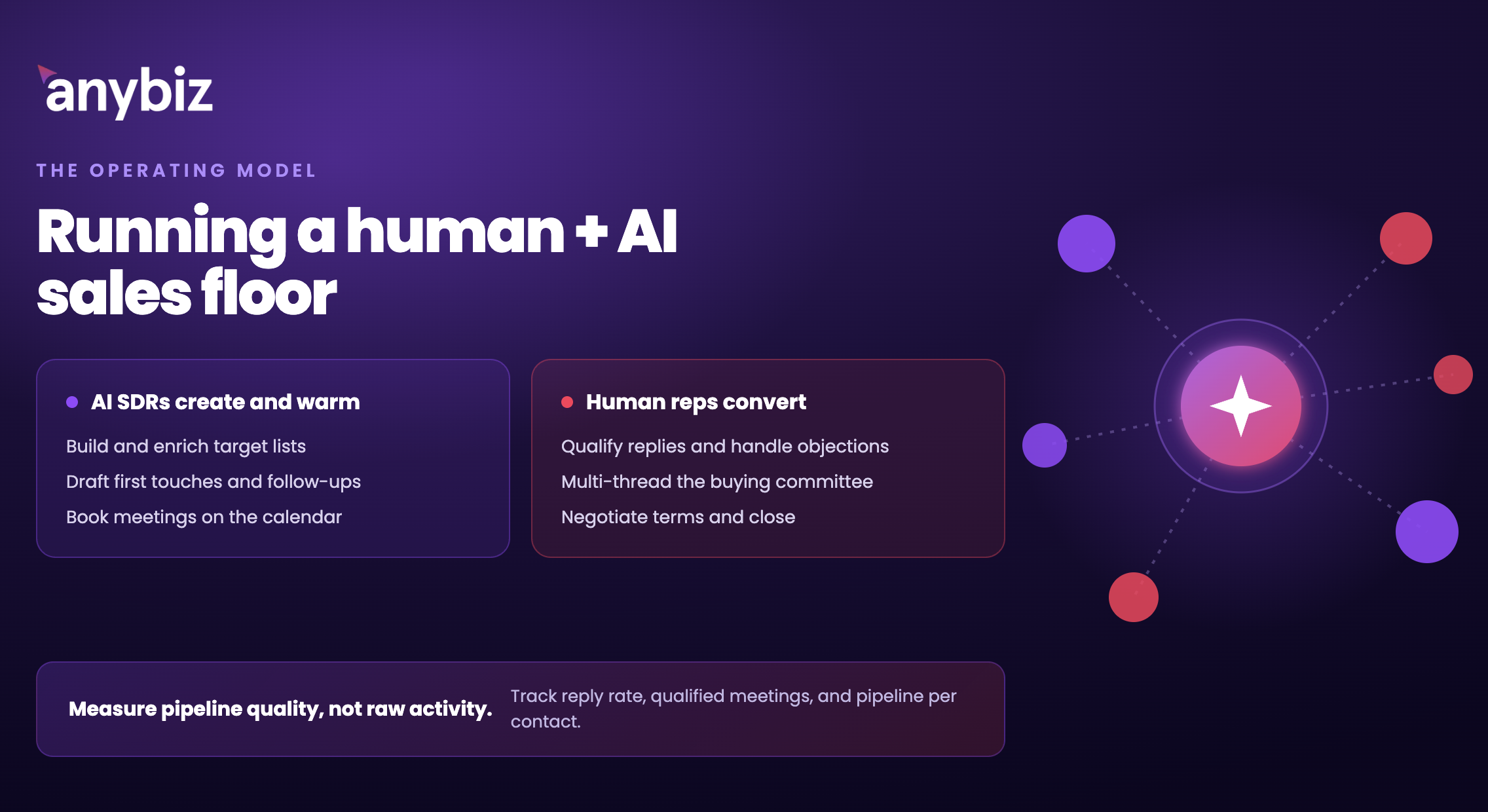
AI SDRs are strongest on the repeatable front end of outbound. They build and enrich target lists, research accounts, draft first-touch messaging, sequence follow-ups, and book meetings on a rep’s calendar.
Salesforce found that sellers expect agents to cut prospect research time by 34% and email drafting time by 36% once fully implemented, which hands a meaningful share of the week back to selling. Top performers are already 1.7 times more likely than underperformers to use prospecting agents for outreach.
Where human reps still carry the deal
The judgment work stays with people. Qualifying a lukewarm reply, handling an unexpected objection, multi-threading across a buying committee, and negotiating terms all depend on reading context an agent does not have.
The pattern that works treats the AI as the layer that creates and warms opportunities, and the rep as the person who converts them. For a fuller breakdown of that split, see our take on AI SDR vs. human SDR.
A framework for running a human plus AI sales floor
The five-step orchestration setup
A repeatable setup keeps the two layers from stepping on each other:
- Define the handoff line. Decide which stages the AI owns end to end and the exact trigger that moves a contact to a human rep.
- Set a messaging review gate. Have a rep approve AI-drafted sequences before they send, at least until the quality holds up on its own.
- Protect the inputs. Agents degrade on stale or fragmented CRM data, so assign clear ownership of list hygiene and enrichment.
- Instrument pipeline quality. Track conversion signals per AI-sourced contact instead of raw send volume.
- Review weekly and reallocate. Move tasks between the AI and your reps based on what the numbers show, not on where you started.
The metrics that prove the AI layer is working
Activity metrics flatter an AI SDR, because volume is the one thing automation produces easily. The signal that matters to a CEO is whether that volume converts. Watch reply rate on AI-sent sequences, the count of qualified meetings those replies produce, and pipeline value created per AI-sourced contact.
If sends climb while qualified meetings stay flat, the targeting or the messaging needs work before you scale it further. That discipline pairs well with a tight prospecting method like our 3×3 B2B prospecting rule.
Common mistakes sales leaders make with AI SDRs
Treating it as a straight headcount swap
The temptation is to read “AI SDR” as a way to cut the SDR line item. The data points the other way. In the Salesforce survey, 94% of sales leaders who use agents called them critical for meeting business demands, yet those same teams still rely on reps to close. Teams that strip out human capacity and expect the agent to carry qualification and conversion tend to watch reply quality and meeting rates slide.
Shipping AI messaging with no review gate
The second common failure is letting agents send at scale without a person checking the output. Salesforce’s own sales leadership has been blunt that agents without full customer context produce weak results, and clean, unified data is what separates useful output from noise. On the deliverability side, high-volume automated sending with thin personalization is a fast way to damage sender reputation and land in spam, which is why messaging review and inbox monitoring belong in the workflow. Regulated markets add another layer, covered in our guide to AI outbound compliance and the EU AI Act.
What to do next
The CEO-level mandate is not going to loosen in 2026. With half of chief executives saying their job depends on AI and the budget doubling to back it, the question reaching sales leaders is direct: can you show pipeline from the human and AI mix you are running. The teams that answer it well have defined the handoff, put a review gate on their messaging, and started measuring the AI layer on the quality of what it produces rather than the volume it moves.
That is the work AnyBiz is built to run.
GET STARTED See how AnyBiz runs AI SDRs alongside your team, and book your first AI-qualified meeting this week. |
BEFORE YOU GO 72% of CEOs already made AI strategy their call. Get the outbound stack that runs itself before your number is the one on the line. |